
HaloPSA lists at about $99 per agent per month on annual billing for teams of up to 24 agents (published pricing summary built on Halo's own calculator), which puts 10 agents at roughly $990 a month, or $11,880 a year, before onboarding. Everything sits inside that one per-agent subscription: ticketing, SLAs, contracts, billing, projects, asset tracking, CRM, reporting and AI. There's no module menu to assemble and no edition to upgrade out of.
The number that reframes the whole conversation is the unit of billing, not the rate itself. As Flamingo's 2026 HaloPSA review puts it, HaloPSA doesn't price by ticket volume, end-user count or data volume. Your bill is a headcount calculation wearing a software invoice. Add a dispatcher and the number moves. Add 500 tickets and it doesn't.
That's why comparing quotes by headline per-seat rate is a mistake. Two MSPs with the same 10 technicians can sign first-year deals thousands of dollars apart on billing term, license type, onboarding scope and procurement channel alone. The only fair comparison converts every quote into a first-year total at the same seat count, the same billing term and the same onboarding scope. What follows is the math to do that, plus the questions worth putting to the vendor before anyone signs.
Table of Contents
- HaloPSA Pricing at a Glance in 2026
- How the Per-Agent Subscription Model Works
- Who Needs a Paid Agent License
- Named Versus Concurrent Seats in Practice
- Costs Beyond the Per-Agent Rate
- Comparing First-Year Totals Across Quotes
- What to Confirm Before You Accept a Quote
- Model Your Seat Count Before You Buy
HaloPSA Pricing at a Glance in 2026
HaloPSA sells one platform at one per-agent price. For US MSPs, a published pricing summary built on Halo's own calculator lists annual-billing rates that step down as agent volume grows: $99 per agent per month for 5–24 named agents, $95 for 25–49, $89 for 50–99, and $85 for 100–250. The same summary reports that all features are included and that onboarding is charged separately according to implementation scope.
That structure gives you something rare in PSA buying: a number you can compute before the sales call. Put your technician count against the band and multiply.
| Agent band | Per agent / month | Example monthly total | Example annual total |
|---|---|---|---|
| 1–24 agents | $99 | 10 agents ≈ $990 | ≈ $11,880 |
| 25–49 agents | $95 | 25 agents ≈ $2,375 | ≈ $28,500 |
| 50–99 agents | $89 | 50 agents ≈ $4,450 | ≈ $53,400 |
| 100–249 agents | $85 | 100 agents ≈ $8,500 | ≈ $102,000 |
Two things the table hides
The first is billing term. These rates assume annual billing, and month-to-month terms are listed higher by enough to decide a close comparison. The second is the band edge itself, which different sources draw differently. One 2026 roundup reports $99 per agent per month for 1–24 agents when billed annually (Flamingo's MSP PSA software pricing roundup), while the calculator-based summary starts that band at 5. Ask which edge your count lands on and get the answer on the paper.
Ask on the call: "Which rate band does my seat count fall into, and is that rate fixed for the full term?"
The edges are worth watching because a band change reprices every seat, not just the new one. Sitting at 24 agents costs 24 × $99, or $2,376 a month. A 25th technician drops the whole team into the next band, where 25 × $95 is $2,375. You add a person and the license bill falls a dollar. That's the sort of detail a band table shows and a sales deck doesn't.
Get the baseline first. Agent count times band rate gives you the subscription line before any extras. If you're still deciding whether HaloPSA belongs on your shortlist at all, our best PSA software comparison runs it against Autotask, ConnectWise and Syncro on the same criteria.
How the Per-Agent Subscription Model Works
Think of HaloPSA as an all-inclusive resort rather than a restaurant with a menu. One price per guest covers the gym, the pool and every restaurant on the property, but every guest who checks in pays it whether they use those facilities or stay in their room all week. Halo's own positioning describes transparent per-technician pricing with one published price and all capabilities included, rather than feature tiers or separate module add-ons, and the included scope is described as spanning ticketing, SLA management, contracts, billing, project management, asset tracking, CRM, reporting and AI.
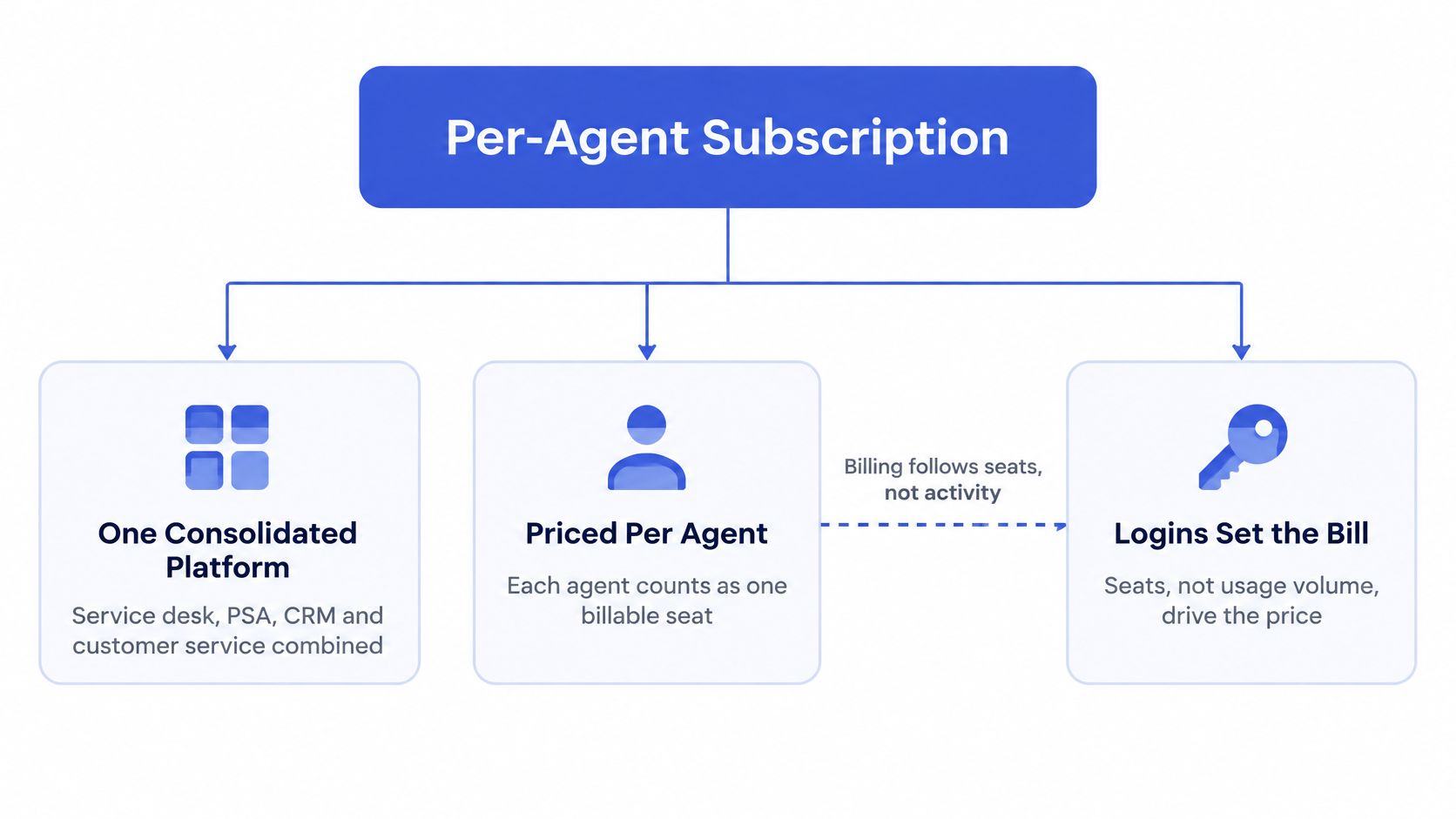
The consolidation is the part buyers underrate. There's no upsell to the "billing edition" or a separate charge for the CRM module, so the only variable left in the subscription line is how many people you license.
The resort analogy holds right up to the front desk. Halo's documentation draws a line between customer-side users and internal agents: users raise tickets, while agents are the technicians who need a license to log into the platform. Client contacts who submit requests don't consume a seat.
You are not paying for usage. You are paying for logins.
That single rule explains most of the confusion around HaloPSA pricing. Ticket volume doesn't move the bill. End-user count doesn't move it. Data volume doesn't move it. What moves it is how many people on your payroll need a login, and how many of them need it at the same moment.
The consequences cut both ways. Adding a technician has a predictable marginal cost, which makes planning easy. The reverse is unused-license expense, because a service manager who logs in once a week still holds a full seat. Audit your occasional users before you sign, not after the first renewal.
For an owner, the budget implication is blunt. The PSA line item scales with how you organize the team, not with how much business you close. Win a client twice the size of your biggest account and the HaloPSA cost doesn't change. Hire two field techs and it does.
Who Needs a Paid Agent License
The rule is short: every agent who logs in needs a license, and end users who only raise tickets don't. Third-party licensing coverage describes HaloPSA as named per-agent licensing with end users and approvers free, and flags a temporary 10-user minimum reported by Software Advice's HaloPSA profile. That floor changes the entry math for a four-technician shop with a part-time dispatcher.
The same coverage lists the questions buyers keep asking and vendors keep leaving open: whether dispatchers, account managers, finance staff, project managers, contractors and occasional technicians are all billable, whether licenses can be reassigned when staffing changes, and how seasonal workers and service accounts are counted. Those are commercial answers rather than product answers. Get them in writing.
| Role | Paid agent license? | Notes |
|---|---|---|
| Service technician who logs in | Yes | Every login requires a named or concurrent license |
| Dispatcher or service coordinator | Yes | Billable as an agent if they log into the PSA |
| Service desk manager | Yes | Manager logins and reporting consume a seat |
| Account manager with no PSA login | No | Free unless they log in; confirm with Halo |
| Finance or billing staff | Only if they log in | Billable when they log in; confirm billing-module access rules |
| Client portal and end users | No | Portal users and end users are free |
| Approvers | No | Reported free in third-party licensing summaries |
| Contractors or seasonal techs | Depends | Named seat if dedicated; concurrent may fit shared use |
| Integration or service accounts | Confirm with Halo | Ask whether service accounts consume a license |
The headcount misconception
A 20-person MSP rarely needs 20 licenses, and a 12-person MSP sometimes needs 14. Billable seats follow who logs into the PSA, not who appears on the org chart, and the licensing coverage above makes the point that named-user pricing turns organizational design rather than ticket volume into the primary cost driver.
Say an MSP has 18 staff: 11 technicians, two dispatchers, a service desk manager, an account manager, two finance staff and a salesperson. Ten of those log in daily, three log in weekly, the rest never do. The quote should be built on the thirteen, not the eighteen.
Do the worksheet before you talk to anyone. List every role, mark yes or no against "needs a PSA login", then mark the yes column again as named or shared. That second count is the number you take into the conversation. If you want product background first, our HaloPSA overview covers what sits behind the price.
Named Versus Concurrent Seats in Practice
Halo issues agent licenses in two forms. A named license is assigned to one specific person. A concurrent license sits in a shared pool and can be used by whichever agent picks it up, with the constraint that only one agent can use it at a time, according to Halo's licensing documentation. Every agent who logs in needs one or the other.
The decision rule is about shape, not size. Stable daily users fit named seats. Shift coverage, part-time technicians, weekend staff and occasional administrators fit concurrent seats, because you're buying simultaneous capacity instead of headcount.
| Team shape | Licenses to buy | People covered | Monthly cost |
|---|---|---|---|
| 10 techs all working daily | 10 named | 10 | $990 |
| 15 techs with peak overlap of 10 | 10 concurrent | 15 | $990 |
| 12 daily techs plus 3 occasional managers | 12 named + 1 concurrent | 15 | $1,287 |
Read the third row carefully. Twelve daily technicians plus three managers who log in a few times a week is 15 people. Fifteen named seats at the $99 band costs $1,485 a month. Twelve named seats plus one shared seat costs $1,287 and covers the same 15 people, a saving of $198 a month, or $2,376 a year, from one licensing decision.
Model peak concurrency, not payroll. The number that sets your bill is how many technicians are logged in during your busiest hour.
Get that number without guessing. Pull your current PSA's or RMM's login audit for two to four weeks and plot simultaneous sessions by hour. If peak never exceeds 10 while 15 people hold logins, the difference is money you keep.
Two caveats before you commit. Confirm which license types are sold in your region, because availability varies by market, then confirm whether the published per-agent rate applies identically to named and concurrent seats. A shared seat priced at the named rate changes the arithmetic.
Costs Beyond the Per-Agent Rate
HaloPSA is publicly listed at approximately $119 per user per month for its all-in-one plan, with a free trial and no free tier, per Capterra's HaloPSA listing. At 10 users that implies about $1,190 a month before taxes, discounts, regional pricing or implementation services. That's the monthly-billing end of the market, and it's the number to hold next to the annual band rates while you work through the rest of this list.
- Onboarding. Quoted separately and priced by scope. Ask what the fee covers: data migration, configuration, workflow build, training and integrations, plus the cutover window. Six figures of configuration nobody scoped is the classic way a first year blows past budget.
- Billing term. The advertised band rates assume an annual commitment. A monthly quote for the same platform lands closer to that $119 figure. Confirm which one your quote uses before you compare it to anything.
- Region and currency. Rates are set per market. A UK pricing summary lists £66 per agent per month billed annually, with ten agents at £660 per month (Helios MSP HaloPSA pricing). Check the currency on the document, not just the number.
- Seat minimums. If a floor applies to your account, your entry cost is the floor rather than your headcount. Ask whether the floor is permanent or temporary, and what happens when you drop below it.
- Contract mechanics. Auto-renewal clauses, uplift language and what the rate becomes at renewal. A discount in year one that resets in year two isn't a discount, it's a delay.
Public figures come from third-party listings, and Halo's pricing can vary by market and by contract. Treat every number here as a starting position rather than a quote. Two MSPs with identical seat counts land on very different first-year totals because of these terms alone.
Comparing First-Year Totals Across Quotes
Two quotes for the same 10 technicians can differ by thousands in year one. The per-seat rate is the visible variable. Billing term, channel and onboarding scope are the ones that decide the total.
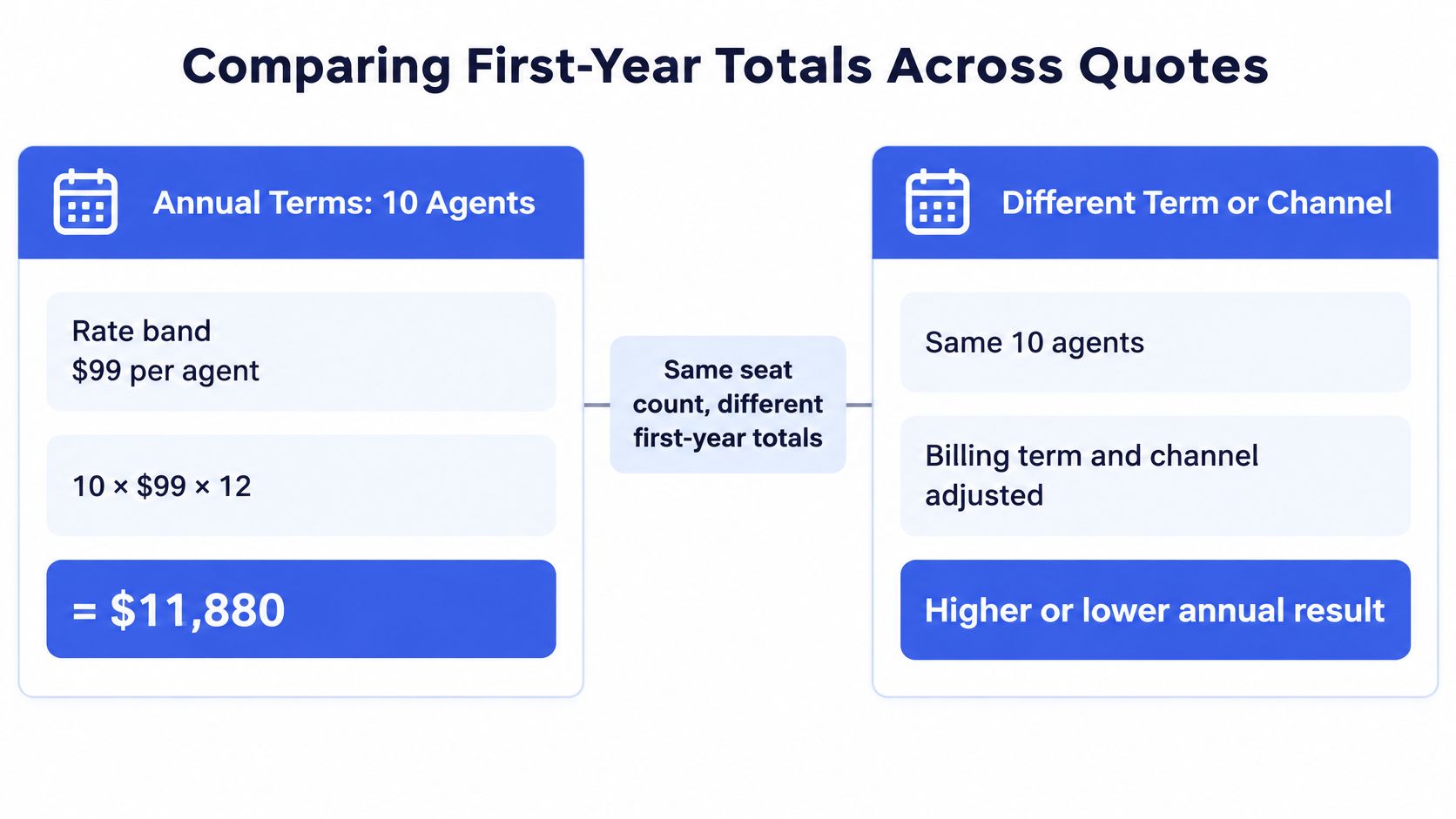
Build the first year as one number. At the listed annual band rate, 10 agents at $99 come to $11,880 for the year before onboarding. On the monthly listing, the same 10 agents come to $14,280, a gap of $2,400 for identical seats and identical features. Scale it up: 25 agents run $28,500 a year at the annual band rate and $35,700 at the monthly listing. Same platform, same technicians, $7,200 apart.
Onboarding is the variable nobody publishes. Since it's quoted by implementation scope, the only way to compare two vendors is to force a number onto the page. Ask each one for the fee and a written scope covering migration, configuration, training and integrations, then add it to the first-year total.
If you want an outside read on how support teams weigh these platforms before they commit, this Mojolin roundup of leading helpdesk tools for support teams is a useful second opinion on the category.
One more angle worth pricing. Vight charges on usage rather than seats: one monthly credit pool, no per-seat fees, month-to-month, first month free. The Starter plan is $250/month for 2,500 credits, around 1,700 tickets a month, with unlimited users, and the Scale plan is $1,650/month for 20,000 credits, around 13,000 tickets a month. Sitting next to a per-agent PSA, that's a different shape of first-year total: one line grows with your headcount, the other with your workload.
What to Confirm Before You Accept a Quote
Every item below belongs on the quote itself, not in a follow-up email. A verbal answer isn't a term.
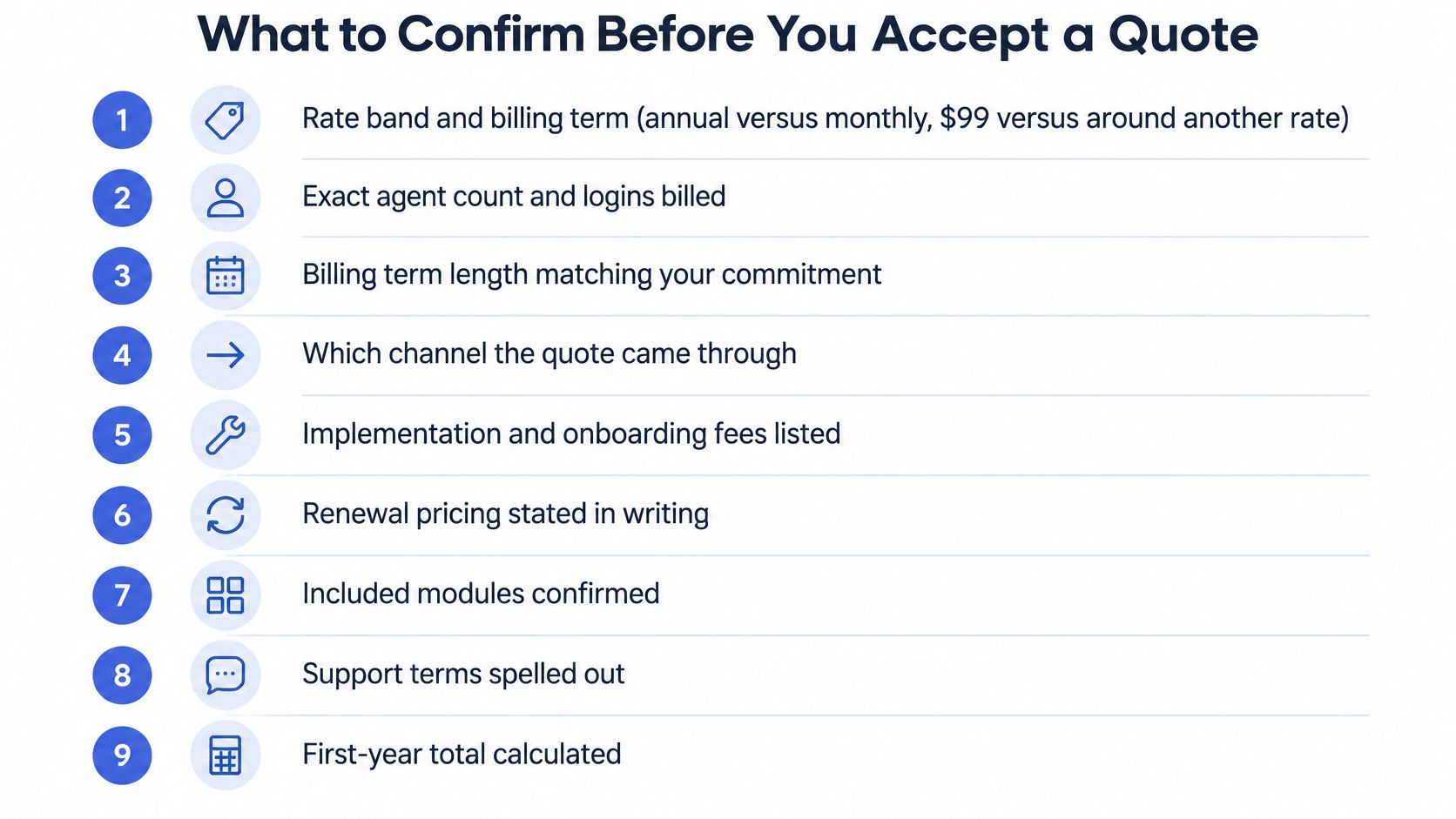
- Rate band and billing term. "Which band does my seat count fall into, and is this the annual or monthly rate?"
- License type per seat. "Which of these seats are named and which are concurrent, and who decides?"
- Reassignment rules. "If a technician leaves and a new one starts next week, can the seat move at no cost?"
- Minimum seat requirement. "Is a minimum in force today, and does it survive renewal?"
- Onboarding fee and scope. "What exactly does the implementation fee cover, and what's excluded?"
- Roles counted as billable. Walk the vendor through your role list, dispatchers and finance staff included, and have them confirm each one in writing.
- Currency, region and taxes. "Is this figure in USD, and does regional pricing apply to my account?"
- Renewal uplift. "What's the maximum percentage increase at renewal, and where is that written?"
- Procurement channel. List price and reseller price are not the same thing. In 2025, DataLunix reported a reseller price of approximately $49 per agent per month for HaloPSA on annual billing, described as savings of up to 50% against the listed price. Before you treat that as the better deal, check what happens in year two, who provides support, and whether the terms match the direct quote line for line.
Number nine is the one people skip and regret. A channel price below list is only a saving if support, renewal and seat changes work the same way through that channel.
Model Your Seat Count Before You Buy
With per-agent pricing, the seat model you design sets the bill. Model it before you request a single quote, and the negotiation becomes a conversation about facts instead of percentages.
- Classify every login. Use the role table, mark each person named or concurrent, and separate the daily users from the occasional ones.
- Sample peak concurrency. Two to four weeks of login data tells you whether shared seats fit. Don't estimate this from headcount.
- Pick the band your count lands in. Know where the edges are, because the 25th agent reprices every seat on the account.
- Add onboarding and confirm the term. The fee plus the annual rate plus the currency is the first-year number.
- Compare on identical assumptions. Same seats, same term, same onboarding scope, same first-year total in the same currency.
Rerun the model every time you hire. Crossing from 24 to 25 agents changes the rate for the entire team, and a model built last year will understate or overstate this year's bill.
An hour of seat modeling routinely saves more than any discount conversation. One is arithmetic you control. The other is a number someone else chose before you walked in. And remember what the PSA does in your stack: Vight doesn't replace it. It integrates directly with your existing PSA to post call notes and time entries, sync tickets and clients, and run ticket AI apps. If you're still working out the staffing side of the equation, our IT staffing ratios breakdown pairs well with this model.
Run the HaloPSA math above and you'll know your seat count, your band and your first-year total before a rep opens a slide deck. Then look at what the per-agent model can't absorb: Vight handles calls, ticket triage and documentation with one monthly credit pool, no per-seat fees, month-to-month terms and the first month free, so adding a dispatcher doesn't add a license. See the plans and start a trial at Vight.